Showing posts with label Juniper Publishers ISI impact factor. Show all posts

Tuesday, February 8, 2022

Holistic Approach for Intervention in Geriatric Male Patient with Parkinson’s Disease: A Case Study - Juniper Publishers

Juniper Publishers-Open Access Journal of Case Studies


Holistic Approach for Intervention in Geriatric Male Patient with Parkinson’s Disease: A Case Study

Authored by Neha Tiwari

Abstract

Parkinson’s disease (PD) occurs most often in the people in their 50’s and 60’s. Hypokinetic dysarthria has been reported to occur in 73% of the patients suffering from PD [1]. The disease is closely related to cognitive difficulties such as impaired attention, disorganized thinking, inefficient processing of abstract new/old information. Speech Language Pathologist’s (SLP) role in the intervention of individuals with PD is not limited to working upon speech impairment but also improving various cognitive functions. This case study reflects the importance of inter-professional collaboration between neurologist, SLP along with other professionals and training of caretaker which plays a crucial role in intervention of individual with Parkinson’s disease. Also, SLP’s focus upon cognitive linguistic deficits, augmentative communication method and communication enhancement strategies could result in achieving communication goals.

Keywords: Parkinson’s disease; Hypokinetic dysarthria; Neurologist; Caretaker training; Physiotherapist

Introduction

Parkinson’s disease is a neurodegenerative disorder which is characterized clinically by resting tremor, bradykinesia, rigidity and postural instability. This condition is caused by the loss of neurons in the substantia nigra of the brain. The main communicative disorder associated with Parkinson’s disease is hypokinetic dysarthria. The speech characteristics associated with hypokinetic dysarthria includes marked reduction in the amplitude of voluntary movements, slowness of movements, initiation difficulties, muscular rigidity, loss of automatic (associated) aspects of movements and tremor at rest [2]. Prevalence studies suggest that up to 30% of patients with PD develop dementia. Dementia in PD patients is often a multifactorial condition [3]. Even, in the absence of dementia, several cognitive difficulties are associated with Parkinson’s disease such as impaired attention, perception/memory, disorganized thinking, difficulty processing information, inefficient retrieval of old and stored information, inefficient problem solving. It is crucial to determine how cognitive abilities affect speech and language in geriatric population with PD. Hence, this case study aims to determine the impact of cognitive abilities over language in geriatric population with PD. The role of SLP to determine an effective treatment plan for improving cognitive skills and communication skills is highlighted.

Case Study

The case is 78 years old male referred for speech therapy from Department of Neurology, Bombay Hospital Institute of Medical Sciences on March 2021 with the diagnosis of Parkinson's disease. He was prescribed Tab Admenta 5mg to be taken after lunch and was also advised physiotherapy by the neurologist. A detailed speech and language evaluation was conducted. His oro-motor examination revealed that the strength and range of motion of articulators was affected. Movements of lips and tongue was found to be impaired and rigidity during movements was observed. On the Consensus Auditory-Perceptual Evaluation of Voice (CAPE V), his voice and resonance were found to be abnormal. He was unable to vary pitch and vocal intensity. Upon multiple attempts, he could phonate for the assessment of maximum phonation duration (MPD) and responded for assessment of diadochokinetic rate (DDKR). His MPD was found to be 7 seconds. The DDKR was found to be very slow. During the testing, speech intelligibility was found to be poor with less than 40% intelligibility. His speech was characterized by loss of modulation with an accelerated and or variable speaking rate causing slurring. He also displayed articulatory imprecision resulting in sound distortions. His comprehension (both auditory and reading) ability was found to be impaired. During evaluation of his memory skills, he did display impairment on tasks involving immediate memory. Recall of categories was also found to be affected but he could recall past memories fairly well. His reading and writing skills are also affected. He was found to be hesitant and unwilling to participate in communication esp. when a question would be asked. It was observed that instead of answering questions, he would begin to narrate incidents related to the questions. If unable to answer, he would get frustrated and agitated because of which the session would get frequently disrupted. After detailed speech and language evaluation, he was diagnosed with hypokinetic dysarthria with deficits in cognitive skills. The therapy sessions were through online mode due to the fear of spread of Covid 19. Since, the virtual mode was used, it was very important to counsel his wife and the care taker to remain actively involved during therapy. The therapy plan was directed upon postural stability, relaxation of upper body through various breathing exercises, oro- motor exercises for better oro-motor functioning. The exercises were demonstrated to the caretaker to be done every day. Cognitive Linguistic Improvement Program (CLIP)was followed which consisted of various memory, temporal orientation and categorization tasks. Activities like naming, lexical retrieval, find the missing objects, pick the odd one out, find the differences, maze games, following pattern were also used as cognitive stimulating activities. Caretaker training was also given once for appropriate home-based management. Upon discussion with the caretaker, therapy sessions were planned to be held twice a week. The duration of therapy session was 40- 50 minutes. 13 online sessions were taken. The caretaker was also counselled regarding use of pictures and test cards as an augmentative communication method.

Results

There has been regular communication between neurologist, Physiotherapist and SLP regarding goals, activities and improvement. The client has been showing improvements in various aspects of cognition that were affecting language. The use of CLIP by SLP in managing cognitive linguistic deficits along with the pharmacological treatment is helping the client’s cognitive capabilities thereby increasing the use of language and interest to communicate. The patient’s frustration has reduced drastically. Care taker training is regularly done as a result of which the caretaker is now able to provide proper home-based management for the client and has a better understanding of the client’s special needs related to Parkinsonism. Constant guidance and counseling are provided by the speech therapist to the client, family members and caretaker. The speech intelligibility has improved to 60% due to various strategies like stressing, slow rate of speech and breaking words into syllables while speaking.

Conclusion

It is important to have a holistic approach in which cognitive, motor (fine and gross) as well as communication difficulties should be managed by a team including neurologist, physiotherapist, SLP and caretaker in management of PD. SLPs role is highlighted in this case study. SLPs are involved in planning & working upon communication goals, guidance of care taker and care taker training. A structured caretaker is recommended in the present case study.

To know more about Juniper Publishers please click on: https://juniperpublishers.com/manuscript-guidelines.php

For more articles in Open Access Journal of Case Studies please click on: https://juniperpublishers.com/jojcs/index.php


Tuesday, April 6, 2021

An Unusual Complication in Johanson’s Staged Urethroplasty: Squamous Cell Carcinoma - Juniper Publishers

For more articles in Open Access Journal of Case Studies please click on: https://juniperpublishers.com/jojcs/index.php

 Juniper Publishers- Open Access Journal of Case Studies


An Unusual Complication in Johanson’s Staged Urethroplasty: Squamous Cell Carcinoma

Authored by Siddharth Pandey

Abstract

Urethral stricture is an uncommon urological condition in developing countries like India. It usually results from trauma, iatrogenic injuries and venereal infections. Penile carcinoma is a common genital cancer with usual risk factors being phimosis, human papillomavirus (HPV) infection, tobacco smoking, sexual promiscuity and poor hygiene. The occurrence of carcinoma in penile stump following Johannson’s staged urethroplasty for anterior urethral stricture is extremely rare. Herein, we report a rare delayed occurrence of squamous cell carcinoma in the penile stump following Johannson’s staged urethroplasty for anterior urethral stricture in a circumscribed man.

Introduction

Stricture urethra and penile carcinoma are two urological conditions which have a major impact on patient’s quality of life[1,2].However, their association is not well described till date. The occurrence of carcinoma penis in circumscribed males is fairly uncommon. Multiple treatments of urethral stricture combined with human papilloma virus (HPV) infection may result in premalignant changes that may subsequently lead to squamous cell carcinoma of the penis. This case pertains to an unusual complication occurring during prolonged management of urethral stricture.

Case Presentation

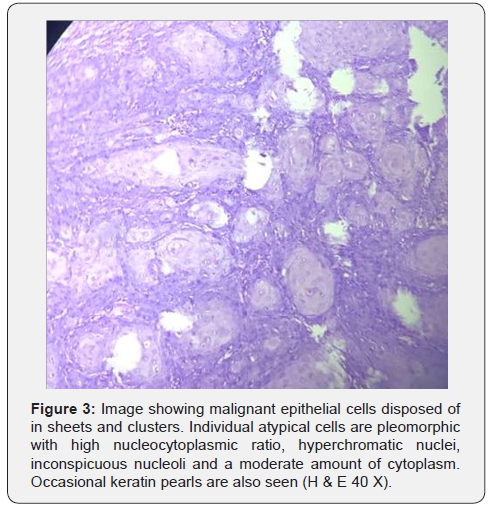
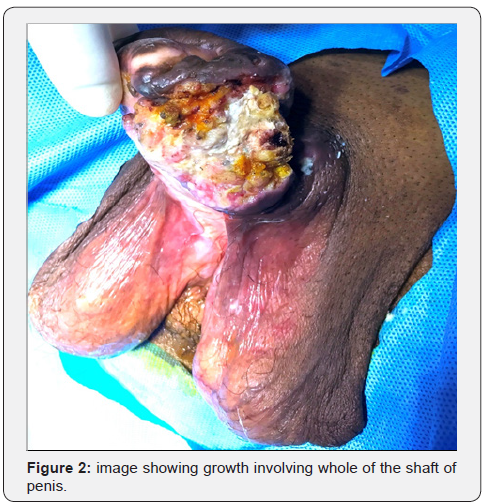
A 66-year-old Muslim man presented with a history of slowly increasing painless growth over the penile shaft for 2-months. The patient had a history of anterior urethral stricture about 3 years back for which he underwent multiple endoscopic visual urethrotomy & urethral dilations followed by Johannson stage I urethroplasty year back. There was no history suggestive of any trauma, drug addiction or sexually transmitted diseases. He had undergone circumcision during infancy. He denied any history of tobacco chewing or smoking. On clinical examination, there was firm non tenderexophytic growth of size 4cm X 4cm involving the entire penile shaft(Figure 1&2) with no enlargement of inguinal lymph nodes. The growth was highly suspicious for malignancy and a wedge incisional biopsy was planned from the growth and surrounding penile tissue. Routine blood and urine investigations were normal. Chest X-ray was unremarkable. HPV testing was not done as routine testing for HPV is not performed at our institution.The wedge biopsy results were suggestive of well-differentiated squamous cell carcinoma of the penis. As the growth was involving the whole of the shaft and due to inability to achieve sufficient penile stump with negative margins, the patient was counselled for total penectomy. The final histopathology analysis revealed moderately differentiated squamous cell carcinoma involving the urethra, penile skin, and underlying subepithelial tissue, with a 1-cm free surgical margin(Figure 3). The patient had a long hospital stay of 15 days for management of local infection of his wound. The patient was advised strongly for elective bilateral inguinal lymph node dissection at 1-month follow-up, but he denied. At present (follow up of 3 months), the patient is doing well & there are no inguinal lymph nodes palpable in the groin.Informed Consent was obtained from patient for publication.


Discussion

Penile cancer is a common male cancer in developing countries like India with known risk factors such as phimosis, human papillomavirus (HPV) infection, tobacco smoking, sexual promiscuity,poor hygiene and low socio-economic status[3]. However, the occurrence of penile carcinoma in patients with long standing urethral stricture is very rare. Till date, only 4 studies have reported the occurrence of penile cancer in patients of urethral stricture[4-7].Kathpalia et al. [4]reported the development of verrucous penile carcinoma in a76-year-old uncircumscribed man fourmonths after undergoing repeated urethral dilatation for bulbar urethral stricture. The patient was managed by partial penectomy[4]. The authors postulated that HPV may play a role as a causative factor in both urethral stricture and penile carcinoma[4]. Malik et al. [5] reported about a 55-year-old man, who underwent total penectomy for a fungating growth over the penis that was initially diagnosed as a case of bulbar urethral stricture & was managed by visual urethrotomy and after a span of three months[5]. The authors proposed that sexually transmitted diseases, especially herpetic infections, may be implicated as an aetiological factor in both diseases[5]. Ahmed et al. [6]reported a case of a 55-year-old man who developed ventral penile masses and scrotal wall swelling after 5 years of repeated urethral dilatation done for bulbar urethral stricture[6]. The lesion was diagnosed as well differentiated penile carcinoma &pseudoepitheliomatoushyperplasia (PEH) and it was managed by total penectomy with scrotectomy[6]. Taneja et al.[7]reported development of squamous cell carcinoma of penis 10 years after patient received treatment for pan anterior urethral stricture[7]. The authors postulated that presence of balanitis xerotica obliterans(BXO) may be a premalignant factor leading to development of carcinoma penis later on in urethral stricture patients[7]. In the present case a 66-year old circumscribed male who underwent repeated treatments for stricture urethra in the span of 3 years developed carcinoma penis. Our case was unique in the extent that the patient was circumscribed during infancy and there were no risk factors or pre-malignant conditions in our patient. It is unlikely that association of long standing urethral stricture and carcinoma penis is merely co-incidental. We can hypothesize that repeated treatments of urethral stricture disease with coexisting latent HPV infection may have lead to pre-malignant changes resulting in development of carcinoma penis later on. The Centers for Disease Control and Prevention (CDC) does not recommend routine screening for HPV in men as there is lack of standardised test and effective therapy for established infection[8]. Although our patient was circumscribed, and HPV testing was not done it has been shown previously that latent HPV infection is present in most of sexually active males[9]. HPV has been implicated in around 48% of penile cancers and it is proposed that oncogenic potential of HPV persists despite undergoing neonatal circumcision[9,10]. The only possible method to prevent HPV infection is vaccination against HPV (especially type 16 and 18)[11]. Hence, it is suggested that sexually active men who have long-standing history of urethral stricture should undergo routine vaccination against HPV. Thus, it is essential to recognize penile cancer early in the clinical setting.Routine follow up and biopsy of suspicious lesions is warranted for early diagnosis.


For more articles in Open Access Journal of Case Studies please click on: https://juniperpublishers.com/jojcs/index.php
 

Juniper Publishers: A Leading Open Access Platform for Global Research in 2025

  Juniper Publishers: A Leading Open Access Platform for Global Research in 2025   Juniper Publishers: A Leading Open Access Platform fo...